
She said I treated her like a bachchi. At another moment, she said I had gone to various people and 'bitched' about her. She also threatened to bring the entire matter to the PM's notice. A revealing excerpt from Subhash Chandra Garg's We Also Make Policy: An Insider's Account of How the Finance Ministry Functions.

Prime Minister Narendra Modi on Friday said both public and private sectors need to leverage synergies and think out of the box to seize opportunities arising as a result of the emerging global environment. While interacting with noted economists and experts at NITI Aayog ahead of the Union Budget, the prime minister also applauded the success of the India Digital story and the rapid adoption of fintech across the country, an official statement said. During the meeting, economists offered suggestions on ways in which India can sustain its development momentum, it added.

First things first: For those wondering if they need to reapply, the answer is no.

The finance minister's legacy will be determined by this year's Union budget.

Surat is home to more than 3,000 large and small polishing companies.

'Are all roads in India privatised? Are governments not playing a role in airports or ports? If they (private players) want to set up lines for a specific requirement, I see no reason to object. It will expand the opportunity and passengers will also benefit.'

'They (government) are trying to create market for pension products'.
However, the budget lacked very specific measures detailing how this will be achieved," the statement said.
"The government has always believed in stable policies. I am sure that this will continue in the coming budget," ICICI Bank's non-executive chairman, K V Kamath, told reporters on the sidelines of a function organised by the Institute of Chartered Accountants of India in Mumbai.
India has been relatively insulated from the severe headwinds in the West. However, with a third of the global economy expected to slip into recession in calendar year 2023, the impact will strongly be felt on India's exports and trade economy, leading economists said in a panel discussion at the Business Standard BFSI Insight Summit in Mumbai on Wednesday. The panel comprised former Reserve Bank of India executive director and former Monetary Policy Committee member Mridul Saggar, State Bank of India Chief Economic Advisor Soumya Kanti Ghosh, Citibank India Chief Economist Samiran Chakraborty, ICRA Chief Economist Aditi Nayar, and IndusInd Bank Chief Economist Gaurav Kapoor. The topic of the panel discussion was No recession in sight: Is India decoupled from developed economies?

'I found it unbelievable that L&T said 45,000 jobs were waiting to be filled because of unavailability of suitable skillsets.' 'So, when the Opposition sweepingly says there are no jobs, I'm sorry... I'm not saying it's raining jobs, but there are jobs. The (skill) gap has to be bridged.'

We should work in unison to boost growth: FM
External commercial borrowings to the extent of USD 1 billion to be allowed for aviation sector for next year.

Sitharaman also listed out various welfare schemes like affordable housing, direct benefit transfer and Ayushman Bharat.

'Interim Budget has ignited the entrepreneurial spirit.'

Multi-asset allocation funds emerged as the most popular option for MFs as they provided the needed flexibility.
India is considering allowing new private sector banks, including by industrial houses, and a roadmap for the same could be announced in the annual Union Budget to be presented later this month.

In times of global challenges, G-20 presidency gives an opportunity to strengthen India's role in the global order, she added. The government is implementing scheme to supply free foodgrains to poor under Pradhan Mantri Garib Kalyan Ann Yojana (PMGKAY) with expenditure of Rs 2 lakh crore from January 1, the finance minister said.

Dr T V Somanathan is the first finance secretary to be appointed Cabinet secretary since 1985. His appointment at this juncture seems to carry much meaning for the forthcoming trajectory of reforms and restructuring of India's steel frame.
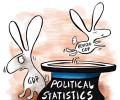
It is also likely to assume a deflator of around 4 per cent. That could take the nominal GDP outlook for FY21 to around 10 per cent. It is this nominal GDP forecast on the basis of which the finance ministry is calculating key Budget targets like the fiscal deficit as a percentage of GDP and tax revenue growth for the coming year.
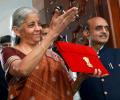
The real requirement for the finance minister's explanatory speech is to explain the measures taken in the Budget to influence inflation and growth not just through the announcement of a deficit goal, but more broadly through the impact on money supply, consumer demand, foreign trade and investment, explains Nitin Desai.

While presenting the Budget for 2022-23, the finance minister also said the strategic transfer of Air India ownership has been completed and strategic buyer for (Neelachal Ispat Nigam Ltd) NINL has been selected. National Asset Reconstruction Co Ltd (NARCL) has commenced its activity, Sitharaman added.
India is only on the starting block.

Bank strike continued for day-two on Tuesday, led by nine unions of public sector banks (PSBs) in the country, opposing government's policy to privatise the lenders. Customers will be inconvenienced to get services such as cash withdrawals, deposits, cheque clearances, remittance services. Government transactions related to treasury as well as business transactions will also be impacted. United Forum of Bank Unions (UFBU), an umbrella body of nine unions, had given a strike call for March 15 and 16.

The capital outlay to cover the modernisation programmes have got a hike of 10.05 per cent.

Likely to be merged with Union Budget from FY18

A look at the world's twenty largest economies, and how much they spend on education as a percentage of GDP
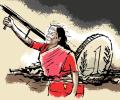
The number of centrally sponsored schemes have increased to 35 in FY22 from 30 in FY21 and central sector schemes have increased to 704 from 685 in the previous year, reports Dilasha Seth.

Sustaining the current 19.5 per cent growth rate in income and corporate tax collections may be difficult in next fiscal year given headwinds from a slowing world and high base effect, a government source said. Net direct taxes, which are made up of personal income tax and the tax levied on corporate earnings, have seen a record growth in current fiscal year, topping up the numbers projected in the Budget. The expected lower nominal GDP growth in 2023-24 on the back of threats of global recession could impact income tax collection, the government source told reporters ahead of the presentation of Union Budget 2023-24 on February 1.

Finance Minister Nirmala Sitharaman announced on Monday a record sum of Rs 1.10 lakh crore for the Railways, out of which Rs 1.07 lakh crore is for capital expenditure, and said the national transporter would monetise the dedicated freight corridors after its commissioning. Presenting the Union Budget 2021-22, Sitharaman also applauded the services provided by the Railways to transport essential goods across the country during the coronavirus lockdown.

The allocation for health ministry for 2017-18 is Rs 47,352.51 crore in comparison to allocation in 2016-17 of Rs 37,061.55 crore.

The political discourse hit a new low on Monday with Union Minister Hardeep Singh Puri making disparaging remarks targeting Rahul Gandhi and the Congress paying him back in the same coin.

Also on the anvil is abolition of distinction between Plan and non-Plan expenditure and replacing it with capital and revenue expenditure

Budget 2018 bears imprints of a government unsure of second term with clear majority, says Shekhar Gupta.

Expressing commitment to augment the country's infrastructure, Finance Minister Nirmala Sitharaman on Monday proposed to significantly enhance capital expenditure to Rs 5.54 lakh crore in the next fiscal, besides creating institutional structures and giving a big thrust to monetizing assets to achieve the goals of the National Infrastructure Pipeline (NIP). Sitharaman said NIP, that was launched in December 2019 with 6,835 projects, has now been expanded to 7,400 projects and around 217 projects worth Rs 1.10 lakh crore under some key infrastructure ministries have been completed. "For 2021-22, I propose a sharp increase in capital expenditure and thus have provided Rs 5.54 lakh crores which is 34.5% more than the BE of 2020-21," the finance minister said.
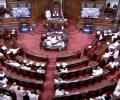
10 vacancies in the Upper House after Rajya Sabha members were elected to the Lok Sabha.

The government on Wednesday approved 12 new industrial cities in 10 states on the lines of Greater Noida in Uttar Pradesh and Dholera in Gujarat to boost domestic manufacturing with an estimated investment of Rs 28,602 crore. These industrial areas will be in Khurpia in Uttarakhand, Rajpura-Patiala in Punjab, Dighi in Maharashtra, Palakkad in Kerala, Agra and Prayagraj in UP, Gaya in Bihar, Zaheerabad in Telangana, Orvakal and Kopparthy in AP, and Jodhpur-Pali in Rajasthan, and one in Haryana. A decision in this regard was taken in a meeting of the Cabinet Committee on Economic Affairs chaired by Prime Minister Narendra Modi.

The session will commence with the maiden address of President Droupadi Murmu to the joint sitting of both Houses of Parliament. The address essentially highlights the government's achievements and policy priorities.

In a boost to the space programme, the government on Wednesday approved the Chandrayaan-4 mission to bring back moon rocks to earth, to send a spacecraft to orbit planet Venus and to expand the Gaganyaan project to build an Indian space station.
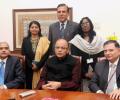
Budget planners for now have been told to prepare with the assumption that GST will apply from April 1.
 © 2026 Rediff.com - Advertise with us - Disclaimer - Privacy Policy - Sitemap - Feedback - About us - Terms of use - Grievances